
Balancing Risk and Resilience: The 2025 AmCham China White Paper
In a dynamic regulatory landscape, Freyr’s AI-enabled solutions are setting new benchmarks for the way people work. This exclusive thought leadership feature from Freyr Solutions Chief Technology Officer Praveen Bezawada explores how AI is not merely a ‘nice to have’ but a strategic advantage essential to driving innovation, mitigating risk, and accelerating time-to-market.
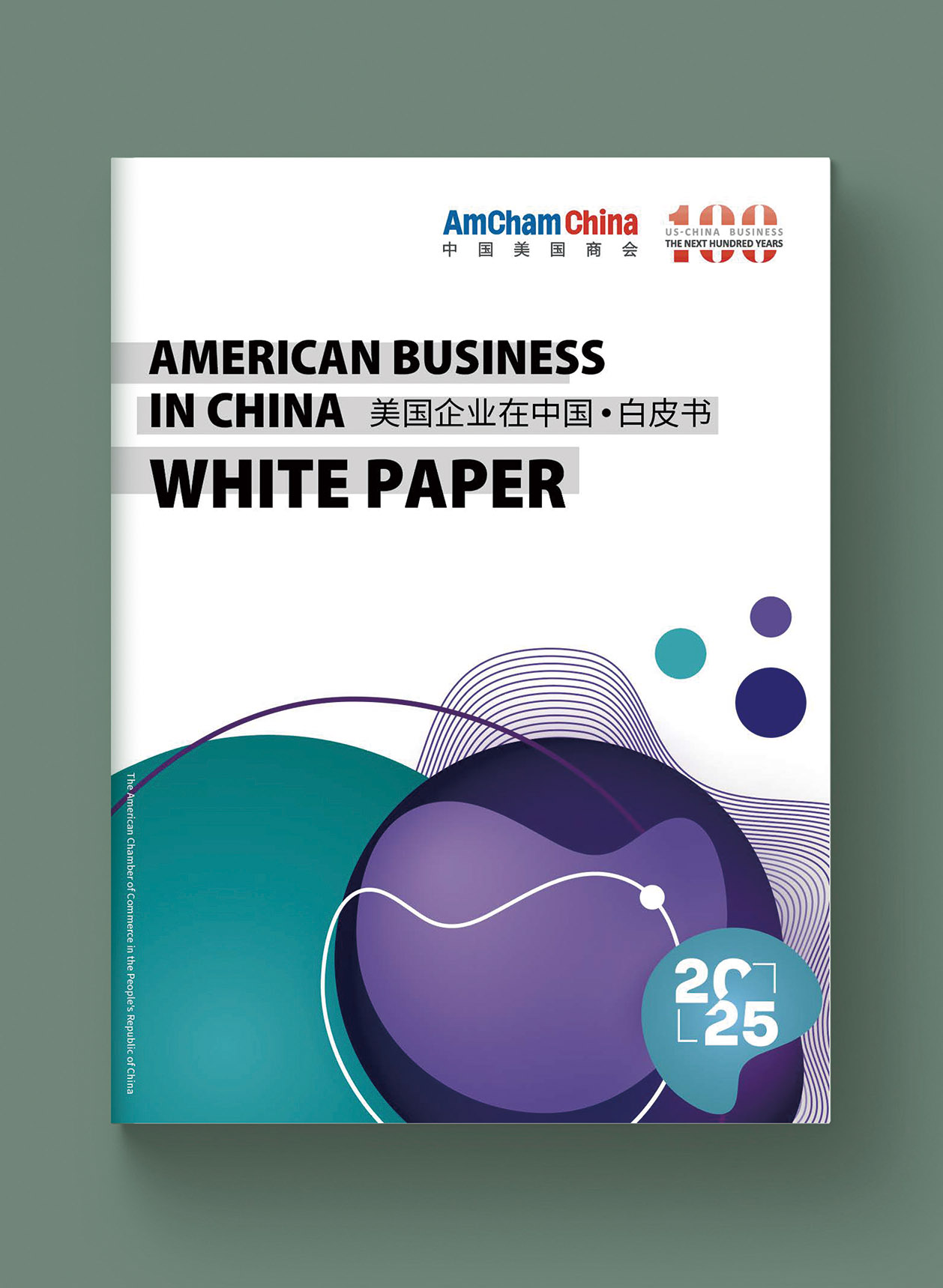
Now in its 27th year, the American Business in China White Paper remains AmCham China’s flagship advocacy document. Drawing on the lived experiences of over 100 member-company representatives, the 2025 edition offers a candid, data-driven account of the challenges and opportunities facing American firms in China today. Spanning 37 chapters and over 600 pages, it provides sector-specific insights, regional assessments, and policy recommendations at a time of growing geopolitical tension and structural economic change.
Business Realities in a Shifting Global Landscape
The operating landscape for American businesses in China is entering a new phase. Heightened geopolitical competition, persistent regulatory complexity, and evolving economic fundamentals have forced companies to reassess risk exposure and recalibrate strategies.
Released in April 2025, AmCham China’s American Business in China White Paper (White Paper) serves as a barometer of this transition—anchored in the lived experience of member companies and their responses to operational challenges across the country. Now in its 27th edition, the White Paper reflects a balanced, business-driven perspective on a relationship under pressure but not beyond repair.
The 2025 White Paper is structured in four parts: a national business environment overview, a focus on market access and industrial policy, detailed sectoral chapters, and regional analyses. Collectively, these chapters represent the expertise of over 100 AmCham China members and speak to the Chamber’s mission of promoting constructive US–China economic engagement.
Rising Geopolitical Tensions and Their Commercial Fallout
For the fifth year in a row, “rising tensions in US–China relations” was identified as the top business challenge by AmCham China member companies in the Chamber’s 2025 Business Climate Survey (BCS). 63% of respondents ranked it above concerns such as regulatory unpredictability or competition from local firms.
The re-escalation of tariffs in April 2025 only deepened commercial unease. While policymakers on both sides of the Pacific emphasize “de-risking” rather than “decoupling,” the distinction often feels academic to companies confronting tightened export controls, ambiguous data regimes, and a politicized trade environment.
Technology-intensive sectors—including semiconductors, life sciences, aerospace, and AI—have been hit particularly hard. In these industries, US and Chinese regulations frequently collide, creating legal ambiguity and compliance risks. The White Paper underscores that while national security is a legitimate concern, more narrowly tailored, transparent policies are needed to prevent unintended business disruption.
At the same time, the Chamber is clear: American companies are not seeking deregulation or special treatment. What they want is consistent, fair enforcement and a rules-based environment that fosters innovation and cross-border collaboration.
Investment: Recalibrating, Not Retreating
While investment sentiment has cooled, American companies continue to see opportunity in China—particularly in strategic sectors aligned with long-term growth. The White Paper reports that 49% of AmCham China members still rank China among their top three global investment destinations, even as only 21% now view it as their top priority market—a significant shift from pre-pandemic levels.
This nuanced view reflects a “China + 1” mindset: companies are not exiting the market but diversifying supply chains and limiting capital exposure amid heightened risk. High-tech and R&D-driven firms continue to expand, with 95% of such companies emphasizing the importance of a stable US–China relationship to their success.
Encouragingly, 46% of companies reported being profitable or very profitable in 2024, and another 36% broke even, underscoring the enduring commercial importance of the Chinese market, even in uncertain times.
“We believe that stable, constructive US–China relations, grounded in transparent policymaking and mutual understanding, are not just vital for business success but critical to global economic stability.”
AmCham China Chair, Alvin Liu
Regulatory Headwinds: Complexity Undermining Confidence
One of the most consistent themes across the White Paper is regulatory opacity. Businesses cite inconsistent policy interpretation, lack of consultation during rulemaking, and unpredictable enforcement as critical challenges undermining operational stability.
Data localization rules, the Anti-Espionage Law, and unclear implementation of the Personal Information Protection Law (PIPL) were frequently flagged in sector chapters. Many companies feel they lack adequate time or guidance to adapt to new requirements, particularly when local and national policies diverge.
The Chamber makes more than 100 recommendations to address these issues, including:
- Clarifying the scope of sensitive data and national security laws;
- Establishing a formal stakeholder feedback mechanism during policy development;
- Creating pilot programs to test cross-border data solutions and allow for corporate adaptation.
At the same time, the White Paper recognizes steps taken by Chinese authorities, including updates to the Negative List for Foreign Investment and the launch of the 2025 Action Plan for Stabilizing Foreign Investment. Still, only one-third of members reported improvement in the regulatory environment; 28% said it had deteriorated.
Sector Highlights: Challenges, Opportunities, and Pathways Forward
The 21 industry chapters in the White Paper provide a granular view of sector-specific experiences. Despite sectoral variation, several common threads emerge:
- ICT and Cybersecurity: Companies remain concerned about compliance ambiguity under China’s cyber laws. The White Paper suggests expanding sandbox trials and clarifying cross-border data protocols to enable digital operations.
- Healthcare and Pharmaceuticals: Regulatory bottlenecks persist, particularly for product registration and pricing mechanisms. However, China’s push for healthcare innovation is opening doors for new investment, especially in local R&D hubs.
- Financial Services: While some liberalization has progressed, foreign players continue to face lengthy approval processes and informal barriers. The Chamber encourages streamlined licensing and improved interagency coordination.
- Education and Professional Services: Complex licensing and local restrictions have made market access difficult. The White Paper urges a unified national framework to replace patchwork local requirements.
These chapters demonstrate that while sector-specific hurdles differ, the overarching demand is for greater clarity, consistency, and consultation.
Regional Focus: Subnational Trends and Local Realities
The White Paper’s regional chapters—covering Shanghai, Tianjin, Northeast China, Southwest China, and Central China—highlight how local policy implementation significantly impacts foreign business operations.
- Shanghai continues to be a leader in digital governance and financial reform. Companies applauded the city’s support for cross-border data pilot zones and fintech innovation but flagged the need for clearer central-local coordination on enforcement.
- Tianjin offers strong infrastructure and workforce advantages, but bureaucratic inconsistencies and regulatory delays remain a challenge. Companies recommend enhanced interdepartmental communication and a local foreign investment liaison body.
- Northeast China faces structural challenges including aging demographics and sluggish private sector reform. The Chamber advocates for targeted tax incentives, improved visa policies, and talent attraction initiatives to reinvigorate the region.
- Southwest China, particularly Chengdu and Chongqing, shows promise in logistics and sustainability. However, local enforcement gaps and unclear approval processes limit momentum. The White Paper calls for implementation audits and stakeholder feedback loops.
- Central China boasts competitive land and labor costs, but regulatory uncertainty—especially around environmental compliance—creates investment hesitancy. Clearer environmental policy guidelines and dispute resolution mechanisms are among key recommendations.
These regional assessments remind readers that China’s business climate is deeply shaped by local governance, with room for reform and tailored engagement strategies.
The Scorecard: Measuring Progress and Accountability
A unique feature of the White Paper is its annual Recommendation Scorecard, which evaluates the status of previous policy suggestions. While progress has been noted in areas such as cosmetics regulation and some aspects of financial sector liberalization, most chapters still report “low” or “no” progress on critical issues.
Top concerns with stagnant or insufficient movement include:
- Equal treatment in government procurement;
- Transparent and timely policy consultation;
- Clarification of IP enforcement procedures;
- Expanded market access for education and professional services.
By tracking progress (or the lack thereof), the Scorecard serves both as a diagnostic tool and an advocacy mechanism. It allows stakeholders to identify persistent challenges and focus future reform efforts accordingly.
The Chamber emphasizes that this process is not intended as criticism, but as a constructive accountability framework. By spotlighting areas where reform has advanced – and where it hasn’t — the White Paper invites continued dialogue and practical collaboration.
A Call for Constructive Engagement
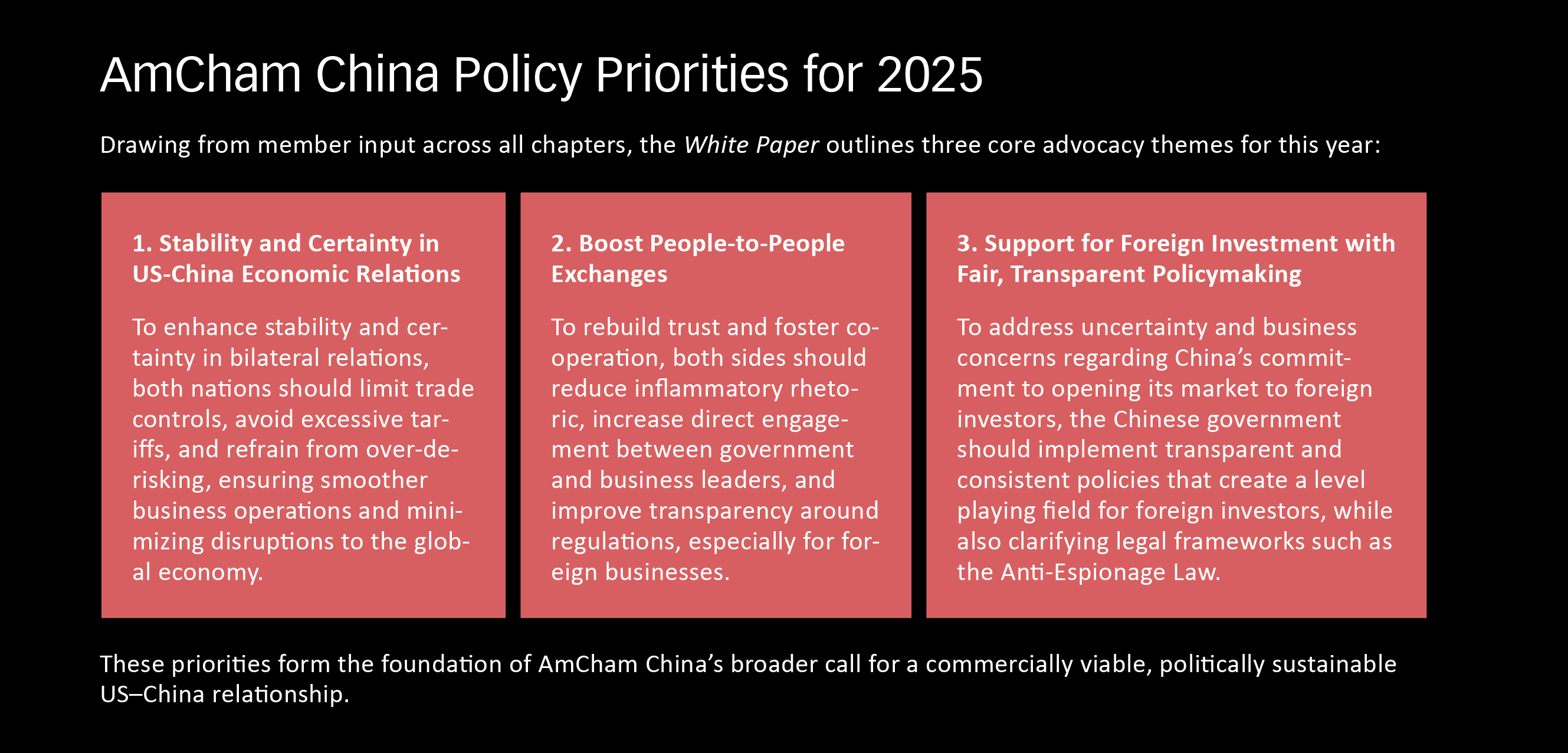
Throughout the 2025 White Paper, one message is clear: despite growing headwinds, American businesses are not giving up on China, but they are adapting. What companies want is not preferential treatment but a stable, predictable policy environment that rewards long-term commitment and fosters innovation.
This vision underpins the Chamber’s broader approach to advocacy. From urging more thoughtful export controls to recommending streamlined visa policies, the White Paper argues that dialogue and transparency can mitigate risk and restore trust.
It also cautions against fatalism. Even in sectors most affected by geopolitical tension, companies see room for practical cooperation. Examples include progress on cosmetics testing protocols, cross-border data pilot programs, and positive local engagement in regions like Shanghai and Chengdu. In short, the White Paper is not just a reflection of business concerns, it is a roadmap for future collaboration.
A Roadmap for Resilient Engagement
At over 600 pages and featuring more than 100 concrete policy recommendations, the 2025 American Business in China White Paper is AmCham China’s most comprehensive policy document to date. It is both a record of challenges and a testament to continued commitment.
As American companies recalibrate in a complex global landscape, the White Paper offers grounded, sector-specific, and actionable insights to support decision-making and advocacy. Whether on regulatory reform, investment climate, or people-to-people ties, it provides a constructive platform for engagement that serves businesses and policymakers on both sides of the Pacific.
For those navigating the uncertain road ahead, the White Paper is a compass. It shows where friction remains, where progress is possible, and, most importantly, where shared interest still endures.

This article is from the AmCham China Quarterly Magazine (Issue 2, 2025). To access the entire publication for free, sign up on our member portal here.