

Escalate or Stabilize? The Uncertain Future of US-China Export Controls
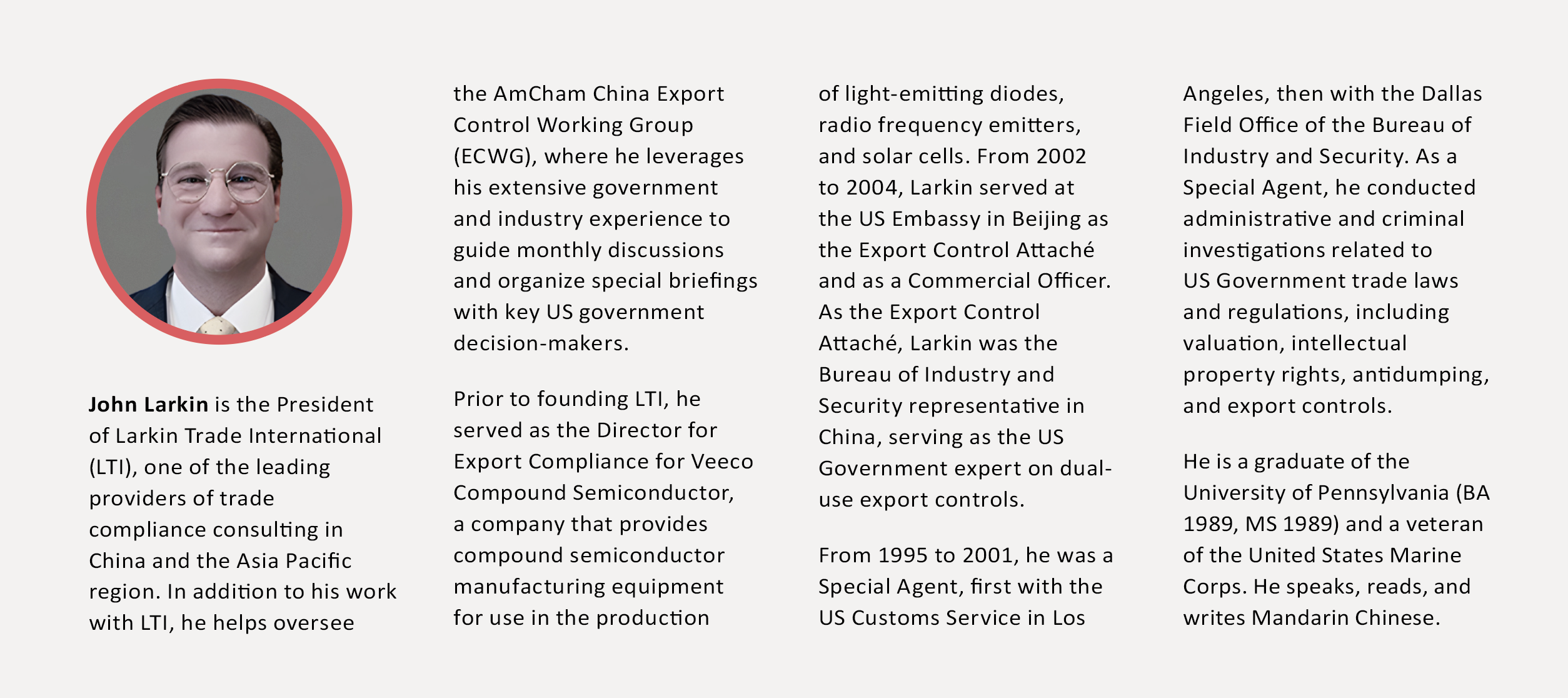
From AI chips to rare earths, dual-use export controls have become central to US-China trade tensions. John Larkin, President of Larkin Trade International and former Export Control Attaché at the US Embassy in Beijing, examines how recent negotiations may shift the landscape, and what that means for businesses on both sides.

Depositphotos.com
Over the past five years, we have seen a rapid expansion of dual-use export controls by both the United States and China, significantly impacting companies on both sides and disrupting global supply chains. This shift is primarily due to the addition of controls over previously non-controlled items and the increased scope of end-use and end-user-based controls. The US has added controls on a variety of items and expanded the scope of its controls on items made outside the US through its Foreign Direct Product Rule (FDPR). China, often in response to the US, has also expanded its controls to cover additional items and more broadly regulate the reexports of its dual-use items outside of China.
Many of these controls have centered around the race for technological superiority in semiconductors and artificial intelligence (AI), particularly a national security imperative for both countries. These controls focus in part on the relevant AI chips themselves, but also cover the technology, software, materials, and equipment for making these chips. The US has focused on semiconductor manufacturing equipment, where it has a dominant position. China, in turn, has focused on rare earths, where it has a near monopoly. Both areas have been, and continue to be, at the forefront of trade negotiations between the two countries.
As trade tensions between the US and China have increased over the past few years, the use of export controls as a tool to gain leverage in negotiations has become central, particularly as the two nations work to arrange a meeting between Presidents Trump and Xi. How this meeting comes about and what results from it will be a key driver of how export controls are implemented moving forward. As we have recently seen with Nvidia’s H20 and now potentially the TikTok negotiations, the two sides can reach consensus on export controls. However, so far, this has occurred more at a transactional level than as part of a broader policy shift.
Diplomatic Stops and Starts
According to recent developments, the US and China remain engaged in talks and are working to arrange a meeting between the two Presidents. During this period, both sides have paused major export control actions. This pause reflects mutual commitments to continued dialogue, as neither nation wants new export control measures to undermine the diplomatic process.
However, a similar pause in tensions nearly broke down earlier this year, following agreements reached during talks in Geneva in May. Shortly afterward, both sides accused each other of failing to meet the agreed-upon obligations. In response, the US took several export control actions. These included halting exports of Nvidia’s H20 chip and EDA tools to China, suspending licenses related to domestic Chinese aircraft and other long-supported programs, and revoking visas for Chinese students.
Fortunately, the US and China quickly recognized that these actions threatened ongoing negotiations and agreed to meet to resolve the issues. Trade negotiators convened in London in June, where they reaffirmed the commitments made in Geneva and took steps to get the negotiations back on track. The US rescinded controls on EDA tools, began processing licenses for the H20 chips, reinstated the previously suspended licenses, and welcomed Chinese students at US universities. In turn, China pledged to license rare earth exports to US companies and took steps to improve and expedite the licensing process for these items. While implementation of these commitments has not been perfect, with companies still facing delays in receiving rare earth licenses from China and H20 chip licenses from the US, both sides have made a genuine effort to uphold their promises.
“As trade tensions between the US and China have increased, the use of export controls as a tool to gain leverage has become central.”
A Fragile Truce
With negotiations back on track, both sides have tried to lessen the antagonistic actions toward each other. As a result, we have seen a significant decrease in additions to the US Entity List and holds placed on new export control regulations, such as the 50% rule that would have expanded the scope of the Entity List to cover subsidiaries of listed entities meeting certain criteria. China has also decreased its actions against US companies through its Entity List and Unreliable List. However, this limited truce remains precarious, as we saw in mid-September when the US added 23 Chinese companies to the Entity List. In response, China announced an anti-dumping investigation into certain analog chips imported from the US and launched an anti-discrimination investigation regarding US measures targeting China’s integrated circuit (IC) sector.
Fortunately, these actions do not appear to have derailed the negotiations or impeded plans for the meeting between the Presidents. In fact, the negotiations continued, and the two sides reached a framework agreement during meetings in Madrid on the TikTok issue. This agreement was finalized during a call between Presidents Trump and Xi on September 19. The negotiations are also proceeding despite calls by President Trump for the EU to impose tariffs on China and India for purchasing Russian oil, which the US would then follow. China has not taken any specific retaliatory actions in response, but it has strongly warned the EU against taking this step.
Corporate Considerations
This back-and-forth on negotiations and the on-again, off-again export control activities does not leave companies with a clear understanding of how this will all conclude. Nevertheless, the fact that the negotiations have survived numerous setbacks bodes well for the US and China to reach a new trade agreement. It is clear from the US side that President Trump wants to reach a trade agreement with China, and President Xi also appears to want a deal. If a deal is reached, we may see a decrease in export control restrictions between the two countries, as seen with Nvidia H20 and TikTok.
With that as a model, we can hope that some export control restrictions will be eased because of the negotiations. From our view, it would make sense for the US to review current technology control levels in the semiconductor sector and adjust them based on China’s current capabilities. It would also be beneficial to confirm the commitment to issuing licenses in support of Chinese programs that the US has supported for many years. On the Chinese side, we would hope to see improvements in the licensing of rare earths and a halt to retaliatory investigative actions taken in response to US export control measures.
In sum, how US and Chinese export controls are applied in the future will largely depend on the progress of ongoing trade negotiations and the agreements reached by Presidents Trump and Xi. If successful, we may see a reduction in export control restrictions and a more stable trade environment. If not, a significant expansion of controls could further disrupt supply chains and raise questions about the long-term reliability of both markets.
We remain hopeful that the former path will prevail. For now, the continued engagement between both sides is encouraging, and reflects a priority long emphasized in AmCham China’s American Business in China White Paper.
This article is from the AmCham China Quarterly Magazine (Issue 3, 2025). To access the entire publication for free, sign up on our member portal here.