
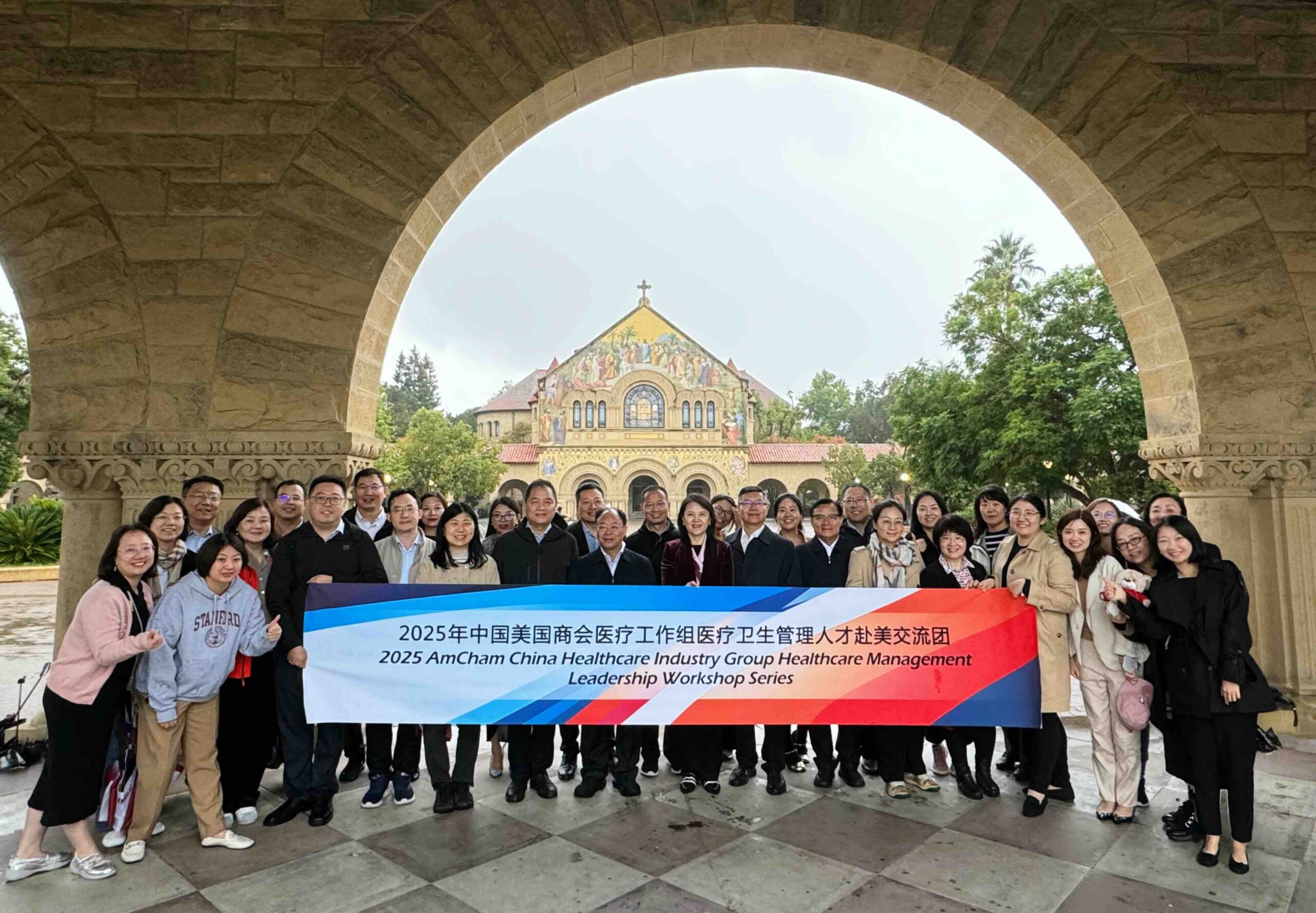
Healthcare security policy is one of the most complex and critical pillars of any public policy system. It not only ensures public welfare but also drives industrial innovation and promotes sustainable social development. Both the United States and China have developed their own institutional practices and exploratory approaches in this field. The US has accumulated extensive experience through its diversified payment systems, commercial insurance mechanisms, and innovations in healthcare service delivery. Meanwhile, China has made major strides in recent years: reforming health insurance payment systems, implementing centralized volume-based procurement for drugs and medical devices, and establishing standardized payment frameworks. Each country’s approach offers unique strengths and valuable opportunities for learning and exchange.
Against this backdrop, the AmCham China Healthcare Industry Group organized another annual healthcare policy exchange visit to the US from October 12 to 18. The delegation held sessions at Stanford University and the Keck School of Medicine at the University of Southern California. Nearly 40 participants joined the visit, including officials from the National Healthcare Security Administration and provincial healthcare security bureaus, heads of medical insurance departments from leading Chinese hospitals, and senior executives from US healthcare innovation companies.
October 13
The delegation arrived in San Francisco on the evening of October 12, to kick off the 2025 AmCham China Healthcare Management Leadership US Exchange. On the morning of October 13, delegation members joined two professors from Stanford University for the US-China Healthcare Policy Exchange Session. AmCham China Vice President Claire Ma delivered the opening remarks, welcoming the leaders, experts, and corporate representatives from both sides. She expressed appreciation for their participation and highlighted the event’s significance in fostering dialogue on US-China healthcare security policies, deepening industry cooperation, and advancing mutual understanding. A senior official from China’s National Healthcare Security Administration also delivered opening remarks. He noted that the exchange offered a valuable opportunity for in-depth dialogue on key topics such as health insurance system development, payment reform, and medical technology innovation.
An expert from the Peking University Public Policy Research Center then gave a detailed presentation on the progress and trends of China’s healthcare security reforms. The lecture reviewed the evolution of China’s healthcare security system and summarized major reform achievements since the establishment of the National Healthcare Security Administration. A health policy and medical innovation expert from Stanford University shared research findings on improving healthcare accessibility for patients with chronic diseases through optimized drug coverage policies.
During the discussion, participants from both sides engaged in a deep exchange on pharmaceutical reimbursement policies. Another Stanford health policy scholar shared insights from developing countries, citing Colombia’s progress toward universal health coverage through a series of incentive policies. These discussions and exchanges of international experiences provided valuable perspectives and new ideas for driving innovation and improvement in healthcare security systems.
That evening, the delegation visited Stanford University, where they learned about its founding history and experienced the rich academic atmosphere and vibrant campus life of this historic and world-renowned institution.
October 14
On the morning of October 14, the delegation visited the University of Southern California (USC) in Los Angeles to begin the next leg of the exchange at the Keck School of Medicine. As USC’s medical institution, Keck is known for its integration of world-class academic research, advanced facilities, and specialized clinical care.
A health policy expert from the USC Price School of Public Policy kicked off the session with a comprehensive presentation on US healthcare reform and insurance payment models. The talk covered the structure of US healthcare security policy, key historical reforms, current challenges, and future trends. This was followed by a lecture titled “DRG Payment Systems, Accountability, and the Application Prospects of Artificial Intelligence,” delivered by a clinical expert from the Keck School of Medicine. The speaker explained the evolution and rationale behind the DRG system, focusing on the advanced APR-DRG model and its defining characteristics.
After the lectures, USC’s Senior Vice Provost for Global Engagement hosted a luncheon discussion with the delegation, where both sides shared views on medical education in the US and China. He expressed interest in strengthening academic collaboration and sustaining policy dialogue between the two countries.
In the afternoon, the delegation visited Children’s Hospital Los Angeles for further exchange. Hospital leaders welcomed the group and shared an overview of the institution. As a leading nonprofit pediatric hospital on the US West Coast, Children’s Hospital Los Angeles plays a major role in clinical care, research, and medical education. The delegation toured several departments, including Neurology, Cardiovascular Medicine, Cell Therapy, and Neonatology, where department heads introduced their clinical practices, technology applications, and service models. The visit provided valuable insight and helped deepen mutual understanding of pediatric healthcare systems.
October 15
On the morning of October 15, the Health Insurance Administrator from the Keck School of Medicine at USC delivered a presentation from the perspective of a private hospital, explaining how medical institutions in the US collaborate with commercial insurers and the federal Medicare program. The session provided a clear overview of how patients in the US choose insurance plans, access care, and receive reimbursements, offering the delegation valuable insight into the structure and operation of the US commercial insurance system. These lessons were particularly useful for informing China’s efforts to integrate basic and commercial insurance data systems and to refine models for medical expense settlement.
Beyond healthcare policy, the group also explored another critical area: medical education. A clinical expert from the Keck School of Medicine gave a comprehensive overview of US medical education models, outlining the medical school training process, residency pathway, and integration with hospital operations. Drawing from years of international exchange experience, the speaker also addressed medical talent development, global collaboration, and emerging trends in the field.
In the afternoon, the delegation visited the headquarters of Edwards Lifesciences for a learning and exchange session with the global management team and China Public Affairs department. Within the context of US healthcare policy, the Edwards team introduced the New Technology Add-on Payment (NTAP) mechanism under the Medicare system, using case studies to explain how innovative products are integrated into reimbursement structures.
October 16
On October 16, the delegation visited Los Angeles General Medical Center. Leaders from the hospital’s Emergency Medicine Department and other divisions provided an overview of the hospital’s operations, budget management practices for public hospitals, and insights into the US “safety-net hospital” system.
Following this, the Strategic Management Lead from Keck Medicine of USC delivered a session on the development of large-scale healthcare systems. The presentation covered the organizational structure and strategic planning framework at Keck, emphasizing collaboration between medical institutions, government agencies, and insurers. The speaker also analyzed capital planning, risk management, clinical integration, and coordination across medical teams.
In the afternoon, the delegation attended a presentation from Boston Scientific’s Health Economics and Market Access team on integrating innovative medical products into US healthcare payment reforms. Using case studies, they explained how the Centers for Medicare & Medicaid Services (CMS), manufacturers, and industry associations jointly promote innovation adoption through the MS-DRG system. This approach helps reduce overall healthcare costs while expanding patient access to new technologies.
Next, the group visited the Norris Comprehensive Cancer Center and the USC Mark and Mary Stevens Neuroimaging and Informatics Institute. At the Cancer Center, directors led a focused tour of radiation therapy facilities and exam areas, providing insight into the role of precision medicine in US cancer research and care. At the Neuroimaging Institute, the director introduced the facility’s research focus and guided the group through its advanced information processing capabilities.
October 17
On the final day, the President and CEO of Keck Medicine of USC met with the delegation. He shared his extensive experience in managing large medical institutions and spoke on how US private healthcare systems collaborate with commercial insurers and implement cost-control measures.
The final session featured the Director of International Programs at the Keck School of Medicine, who offered a comprehensive overview of US healthcare security policy. The discussion addressed current system challenges and future development trends, followed by a lively Q&A session where participants exchanged ideas and drew inspiration from one another. To conclude the visit, the delegation toured Keck Hospital of USC, visiting key areas including waiting zones, exam and check-up rooms, infusion stations, and the Intensive Care Unit (ICU).
The delegation concluded its week-long exchange at Stanford University and the Keck School of Medicine at USC with a deeper, more comprehensive understanding of the US healthcare system. Through policy discussions, academic lectures, hospital tours, and direct engagement with healthcare professionals, participants gained valuable insights across a wide spectrum of issues.
As the world’s two largest economies, the United States and China share a vital responsibility to foster healthcare collaboration, not only for the benefit of their own citizens, but also to contribute to global health progress. From insurance reform to talent development and innovation, both countries continue to learn from each other.
We hope this exchange has strengthened mutual understanding and will help promote further cooperation in healthcare policy. By adapting and applying best practices to their own national contexts, both countries can work toward building more efficient, inclusive, and innovative healthcare systems.
Click here to learn more about AmCham China’s Healthcare Cooperation Program.