
US-China Trade War: How Did We Get Here and What’s Next?
By Mark Dreyer
Months before Donald Trump returned to the White House in January 2025, he was reminding the world that tariffs were his weapon of choice. By spring, the United States and China were once again locked in a cycle of escalation, with tariff levels hitting historic highs and both sides scrambling to absorb the impact. But high-level meetings in Geneva, London, Stockholm, and Madrid were bilateral attempts to de-escalate the situation and find consensus. This article traces that journey: from Trump’s inauguration and the rapid escalation of tariffs, through four European meetings that revealed both the depth of division and the pressure to stabilize.
Depositphotos.com
Within weeks of President Trump’s inauguration, US-China trade relations were back on a collision course – an unsettling echo of his first term, but faster, sharper, and with broader stakes. Tariff hikes were matched by retaliatory measures, disputes spilled across sectors from semiconductors to shipping lanes, and the World Trade Organization was again sidelined – perhaps, this time, for good. US businesses braced for higher costs, Chinese exporters scrambled for new markets, and yet neither government could afford to let the conflict spiral unchecked.
Amid this turbulence, Europe emerged as the neutral stage for dialogue. From the first exploratory encounter in Geneva to subsequent rounds in London, Stockholm, and Madrid, US and Chinese officials circled each other in a series of highly scrutinized meetings. While these sessions did not yield a breakthrough, they offered a rare counterpoint to months of relentless escalation.
From Phone Call to Tariff Crossfire
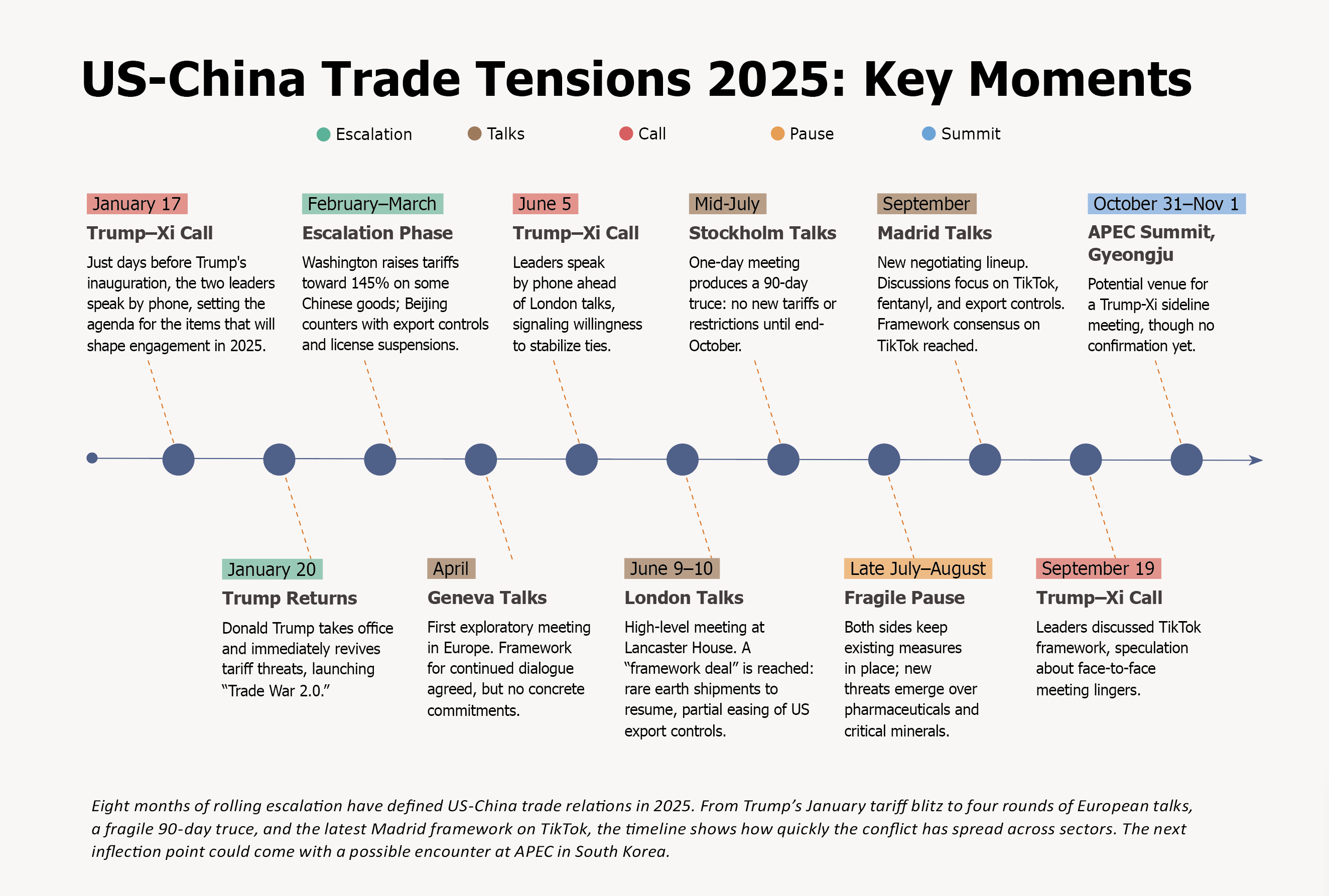
The warning signs were already flashing before Trump moved back into the White House on January 20. Just three days earlier, he had spoken with Chinese President Xi Jinping in what was billed as a goodwill phone call, but the optimism proved fleeting. Within hours of taking office, Trump announced his intent to slap tariffs on a broad range of imports, reviving his signature tactic from 2018.
By early February, those intentions had hardened into action. Washington unveiled a universal 10% tariff and doubled levies on Chinese goods to 20%, scrapping exemptions for small e-commerce parcels – known as de minimis – in the process. Beijing retaliated quickly, raising duties on US agricultural products and tightening export controls on critical minerals. It also widened the battlefield by opening antitrust probes into American companies, including Google, and adding more firms to its Unreliable Entities List.
The tit-for-tat dynamic accelerated through March. Trump rolled out sweeping tariffs on steel and aluminum and moved to expand restrictions on Chinese technology firms, citing national security concerns. China countered with higher duties on US farm goods, sanctions on American companies, and threats to withhold rare earth exports. As the rhetoric escalated, tariffs reached 54% by the end of March, with Trump threatening to push the rate well into triple digits if Beijing did not yield – far beyond what most analysts had considered possible.
April brought the sharpest escalation yet. On April 2, Trump declared a “Liberation Day” for American industry, announcing a universal 10% tariff on all imports alongside a 54% levy on Chinese goods. Within days, China struck back with new tariffs of its own, export curbs on rare earth minerals, and expanded investigations targeting US firms operating in its market. Both sides piled on sector-specific measures: Washington hit solar cells, shipbuilding, and maritime shipping; Beijing targeted chemicals and announced further curbs on critical exports.
By mid-April, the headline tariff rate had soared to 145%, a number designed more for psychological impact than for practical implementation. Yet even this did little to calm markets or reassure businesses caught in the crossfire. Meanwhile, US importers faced ballooning costs, and Chinese exporters scrambled to preserve market access.
The result was a stalemate: neither side was winning, but both were bleeding. It was against this backdrop of spiraling tariffs and mutual damage that Washington and Beijing agreed to meet in Geneva in May – the first serious attempt under Trump’s second term to test whether dialogue could lead to de-escalation.
Geneva: First Face-to-Face Negotiations
The Geneva meeting, the first formal dialogue of Trump’s second term, was less about reconciliation and more about managing the pace of conflict. Both sides arrived with sharply defined objectives. The US delegation, led by senior trade adviser Scott Bessent, also included USTR Jamieson Greer – who had held a video call in late March with Chinese Vice Premier He Lifeng – framed the talks around fentanyl, arguing that punitive tariffs were necessary to compel Beijing to do more to curb precursor exports. Meanwhile, He Lifeng and the Chinese delegation sought to steer the discussion toward restoring stability and rolling back what it described as unilateral and illegal measures. With pressure mounting, Geneva became the forum for testing whether either side was willing to blink.
The outcome was modest but not insignificant. Both parties agreed to lower reciprocal tariffs from 125% to 10% for 90 days, bringing the effective rate on Chinese goods down to around 30% (including the 20% fentanyl-related levy). Non-tariff countermeasures were suspended, and the two sides pledged to keep channels open for further discussion. For businesses battered by months of uncertainty, the agreement offered a temporary reprieve.
Yet the limitations were clear. Geneva did not address the structural issues at the heart of the dispute: subsidies for Chinese industries, US technology restrictions, or China’s use of export controls. Nor did it create a framework for permanent de-escalation. Instead, it functioned as a pressure valve, preventing further escalation while leaving the underlying conflict unresolved.
Still, the symbolism mattered. After months of tit-for-tat tariff hikes, Geneva showed that dialogue was still possible – and that Europe could serve as neutral ground for talks neither Washington nor Beijing could comfortably host. It was enough to set the stage for a second meeting in London the following month, though few expected that session to deliver more than another fragile pause.
London: Partial De-escalation, Focus on Rare Earths
If Geneva was about testing the waters, London was about raising the stakes. On June 9-10, US and Chinese negotiators gathered at Lancaster House, the historic government venue near Buckingham Palace that often hosts high-level summits. Over two days of six-hour-plus sessions, the talks brought an expanded cast of officials and a sharper focus on the nexus between tariffs, export controls, and critical materials.
The US side, still anchored by Treasury Secretary Scott Bessent and Trade Representative Jamieson Greer, added two heavyweights: Commerce Secretary Howard Lutnick and Jeffrey Kessler, Under Secretary of Commerce for Industry and Security. Their presence signaled that Washington wanted the talks to address technology and export licensing, not just headline tariffs. China elevated its delegation as well, with Commerce Minister Wang Wentao joining Vice Premier He Lifeng and Vice Minister Li Chenggang.
The backdrop was a June 5 Trump-Xi phone call, widely interpreted as an attempt to reset the tone after weeks of tit-for-tat license suspensions and export restrictions. In that spirit, the London discussions were candid and intensive. Chinese statements afterwards described the meetings as “constructive,” noting that the two sides had reached a framework for implementing prior consensus and had made progress on mutual trade concerns. They reiterated familiar talking points – that trade relations should be mutually beneficial, and that China does not seek a trade war but is not afraid of one.
The US response was more cautious, but Lutnick struck an upbeat note, telling reporters that the new framework put “meat on the bones” of Geneva’s limited agreement. President Trump was even more characteristically blunt, declaring, “We are doing well with China,” though he acknowledged the process was “not easy.” Behind the optimism, US officials hinted at tactical recalibration: reports suggested Washington was open to easing export controls in sectors such as commercial aviation and semiconductors, potentially allowing Nvidia to sell its new B40 chip into China. In return, Beijing was expected to accelerate approvals for rare earth shipments – a crucial input for both defense and clean energy supply chains.
Still, the limitations of London were clear. No binding commitments were announced, and industry insiders noted the lack of transparency around US licensing decisions, which in some cases had bypassed normal interagency review. Chinese analysts also pointed to internal divergences within the US team as a possible obstacle to durable progress.
Stockholm: A 90-Day Pause
By mid-July, the trade dispute had begun to spill into new sectors, with Washington threatening fresh tariffs on Chinese pharmaceuticals, including fentanyl precursors, while Beijing weighed curbs on exports of gallium and graphite. Against this fraught backdrop, negotiators convened in Stockholm for the third round of European talks eager to come to an agreement before Geneva’s 90-day pause expired on August 12.
The meetings were deliberately lower-key than London, held over a single day in the Swedish capital. Treasury Secretary Scott Bessent once again led the US side, joined by a slimmed-down team, while Vice Premier He Lifeng headed the Chinese delegation. The tone was less about hammering out new frameworks than about preventing the fragile détente from collapsing altogether.
The main outcome was what officials described as another “90-day truce.” Both sides agreed to refrain from imposing new tariffs or restrictions through the end of October, while technical working groups would explore possible compromises on export controls, rare earths, and pharmaceuticals. For Washington, the pause bought breathing space before the summer recess, easing pressure from US manufacturers warning of supply-chain shocks. For Beijing, it secured short-term access to critical technologies while keeping rare earth exports flowing.
Madrid: TikTok-ing Toward a Deal
The fourth round of European talks took place in Madrid in mid-September 2025, following on from calls earlier that month between Secretary of State Marco Rubio and Chinese Foreign Minister Wang Yi and between US Secretary of War Pete Hegseth and his counterpart Admiral Dong Jung. In Spain, the US sought commitments from China on fentanyl enforcement, a reduction in export controls, and guarantees of fair competition. Beijing, for its part, pressed for tariff rollbacks, relief from the Entity List, and assurances against unilateral tech sanctions. Both delegations framed the discussions as pragmatic but cautious, emphasizing stability over breakthrough outcomes.
TikTok, which had been given a reprieve by President Trump on his very first day in office, dominated the agenda. According to Xinhua, negotiators reached a “basic framework consensus” on resolving TikTok-related issues cooperatively, reducing investment barriers, and promoting economic and trade cooperation – but, in the immediate aftermath of the talks, it was anyone’s guess how that would actually work in reality. Crucially, questions remain over how much access or modification US investors will gain of TikTok’s vaunted algorithm, and whether a transitional arrangement will be required.
So Where Does This Leave Us?
After eight intense months of escalation – from the early-2025 tariff surges, export controls, and sectoral bans to four rounds of European talks – bilateral trade relations are, as ever, balanced on a knife edge. The worst of the tariff spikes seem to be in the rearview mirror, but the underlying tension remains, and many more recent flashpoints – not to mention longstanding issues – remain unsettled. Neither side seems poised to capitulate, but neither can ignore the cost of continued inactivity.
Europe has played an outsized and somewhat unexpected role in this arc: as neutral ground for negotiating teams, as a stage for announcements, and as a signal to global business that some norms may hold even in a volatile moment. For US companies, inflationary pressure, disrupted supply chains, and uncertainty over export licensing and tariffs are mounting, while Trump’s farming base in the US heartland is starting to feel the economic pinch. For China, external demand is softening, export volumes in certain sectors are squeezed, and industrial overcapacity is being scrutinized both at home and abroad.
Going forward, several dynamics look key. Trump faces a domestic audience that expects visible wins – lower prices, stable supply, relief for affected industries – especially with the 2026 mid-term elections on the horizon. Meanwhile, China is unlikely to offer large structural concessions without secure guarantees against tech sanctions or adverse legal exposures, while it attempts to balance stimulus and industrial strategy. As a result, it seems likely that smaller, sector by sector deals (TikTok, rare earths, export licenses etc.) are more feasible than sweeping trade treaties or balanced comprehensive agreements.
To Meet or Not To Meet
One looming question surrounds the timing of a planned meeting between Presidents Trump and Xi. A phone call between the two took place following the Madrid talks, with details on the framework of a TikTok deal trickling out in subsequent days. At the same time, the latest reports suggest Trump may visit China in early 2026, with Xi set to make the return trip later next year.
Meanwhile, the APEC meeting – set for October 31-November 1, 2025, in Gyeongju, South Korea – may provide another venue for a face-to-face meeting. If it happens, it could mark a turning point: not because it guarantees resolution, but because leader-level engagement can shift expectations and set the terms for what’s politically possible.
2026 and Beyond
Less than a year into Trump’s second term, the trade war 2.0 has proven faster, broader, and more unpredictable than its predecessor. The four European meetings didn’t resolve the core tensions – tariffs, export controls, technology access, supply chains – but they have marked the battle lines, showing each side a clear picture of what to expect. Madrid didn’t deliver a deal, but it reinforced the pattern: rounds of escalation, followed by negotiations that buy breathing room. The question now is whether we’re seeing the start of a new negotiation cycle, or just another pause in a longer, bumpy contest.
If the Trump-Xi call or meeting leads to even modest progress – on TikTok, export licensing, or tariff rollbacks – it will show that diplomacy still matters. But unless there are clear guardrails for how both sides behave between conversations, the underlying friction remains. And when the next crisis strikes, it won’t take much for the cycle to snap back.
Mark Dreyer is the Senior Director of Marketing & Communications at AmCham China
This article is from the AmCham China Quarterly Magazine (Issue 3, 2025). To access the entire publication for free, sign up on our member portal here.