
2026 Two Sessions in Review
Contributed by Brunswick Group
On March 12, China concluded its annual “Two Sessions”—the meetings of the National People’s Congress and the Chinese People’s Political Consultative Conference. This year carried added weight. Alongside this year’s plan, the 15th Five-Year Plan was released, setting the direction and development objectives for the decade. This abridged version of a report from AmCham China member Brunswick examines sector-specific implications and distills the major themes that will matter most for the year ahead and for the next five years.
Depositphotos.com
Launch of the 15th Five-Year Plan (2026–2030)
The Five-Year Plan is the central organizing document of China’s economic and industrial development system. For those invested in or exposed to China, it is essential to understand not only the objectives set each year at the Two Sessions, but also the direction embedded in the Five-Year Plan and how this aligns with longer-term 2035 goals. Goals are systematically driven forward.
The 15th Five-Year Plan is iterative and does not represent a break with the past. Three themes stand out: first, tech capability is now embedded directly into economic security and geopolitical positioning; second, opening-up continues on more defined terms, with investment increasingly seen through a security lens; and third, national security is now a structural imperative, woven through energy, food, finance, tech, and data governance.
Taken together, the Plan signals not a change in course but a tightening of integration between industrial policy, economic security, and geopolitical positioning—and this alignment will shape the operating environment.
Consumption: A Priority and Challenge
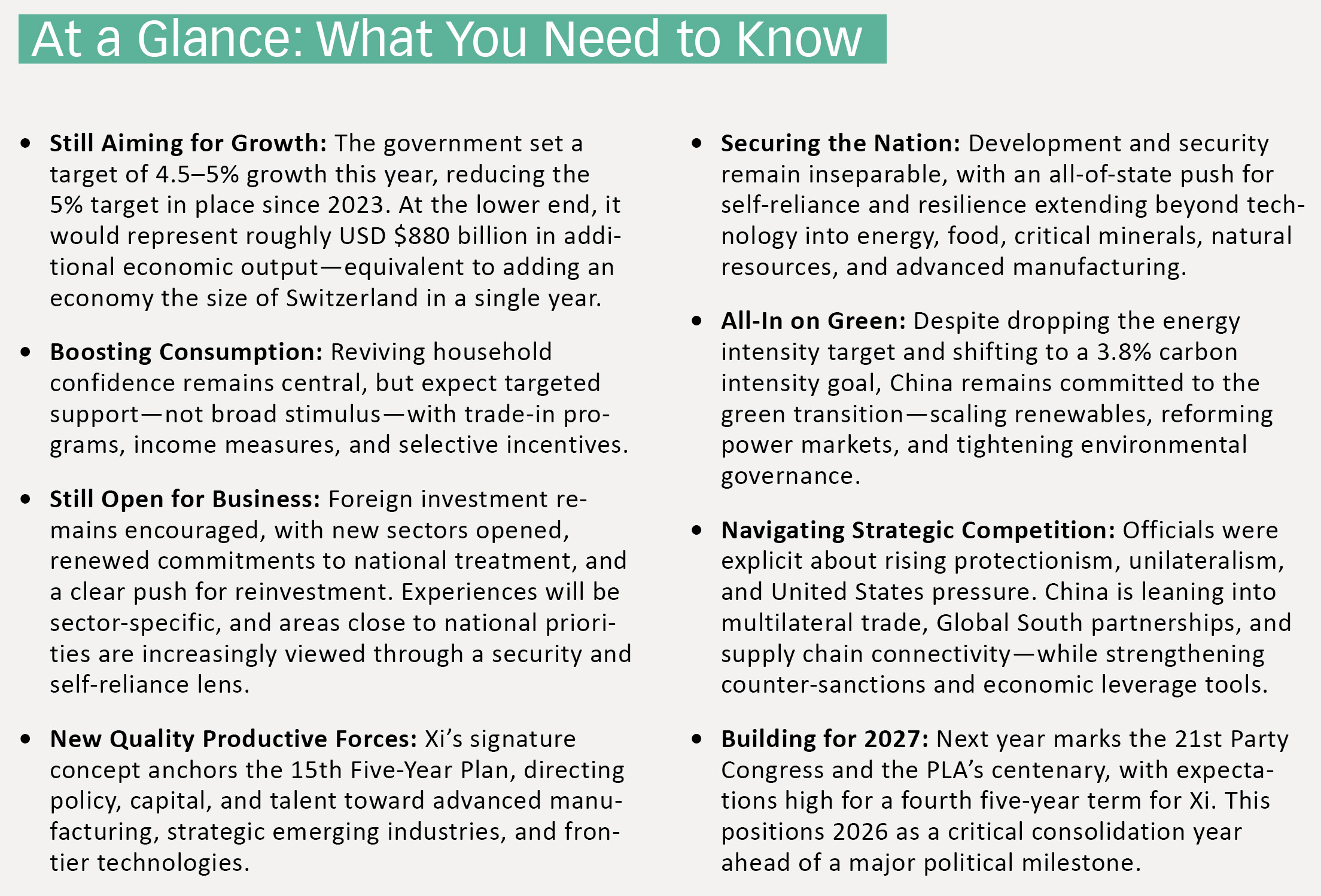
The Premier made clear that boosting consumption is the top macro priority for the year ahead. Since 2023, policymakers have avoided large-scale stimulus—that path continues. What has shifted is recognition that weak consumption is structural; rebuilding household confidence requires more than short-term subsidies.
The Premier introduced an income enhancement plan for urban and rural residents, supporting consumption via wage growth, social security reform, and property income. RMB 250 billion (US $35 billion) in ultra-long special treasury bonds will fund consumer goods trade-in programs—modestly below last year’s RMB 300 billion—while RMB 100 billion (US $14 billion) in a new fiscal–financial coordination fund will deploy interest subsidies and risk-sharing tools.
Trade-in programs remain central: in 2025, related measures drove more than RMB 2.6 trillion (US $360 billion) in sales. The 2026 package leans more heavily into services and experience-based consumption—tourism, culture, sports, and entertainment—alongside expanding duty-free locations to convert inbound travel into domestic retail spending. Officials highlighted inland regions as the next source of demand.
National Security and Self-Reliance
This year’s Two Sessions reinforce Beijing’s all-of-state approach to tech security. The 15th Five-Year Plan positions tech capability and self-reliance at the center of national strategy, with President Xi emphasizing the need to align innovation, industry, capital, and talent within a coordinated system. The National Development and Reform Commission (NDRC) spoke about strengthening China’s “national innovation system,” linking policymakers, national laboratories, universities, state-owned enterprises (SOEs), and private tech firms across the full research-to-commercialization cycle.
The Plan identifies strategic emerging industries—including AI, biomedicine, integrated circuits, and new energy vehicles—as immediate scaling priorities, alongside longer-horizon frontier bets: 6G communications, humanoid robots, quantum technology, and general artificial intelligence.
Fiscal and financial levers are aligned in support. The Plan calls for annual research and development (R&D) spending growth of more than 7%, with total outlays exceeding RMB 4 trillion (US $560 billion). Authorities are improving exit channels through streamlined initial public offering (IPO) and mergers and acquisitions (M&A) processes and steering national-level venture capital into strategic sectors.
Artificial Intelligence
Artificial intelligence was a defining theme of this year’s Two Sessions, embedded throughout the 15th Five-Year Plan. The Plan references artificial general intelligence for the first time, calling to “explore development paths” for it. The release of DeepSeek last year and the rapid emergence of advanced domestic large-scale models has reinforced this direction; the NDRC noted that China “now leads the world in terms of open-source AI models.”
Policy focus is twofold: on the science side, heightened attention to compute capacity, foundational model architectures, and data systems; on the application side, accelerating integration into production systems and public services under an expanded AI Plus Initiative. The NDRC underscored the imperative to build a “self-reliant AI ecosystem,” with data formalized as a strategic production factor.
Securing the Nation: Defense and Military
The Premier reaffirmed the Party’s absolute leadership over the armed forces, making clear that final authority rests with Xi Jinping as Central Military Commission (CMC) Chairman. With next year marking the centenary of the PLA, advancing combat readiness and accelerating high-quality military modernization has been made a priority. The Ministry of Finance announced a 7% increase in national defense spending to RMB 1.91 trillion (US $265 billion), consistent with recent annual increases.
Civil–military integration remains central to defense strategy. Work Reports call for strengthening resource sharing between civilian and military sectors and integrating regional economic development with defense planning. For foreign investors, the boundary between commercial and strategic sectors will remain under high scrutiny. Regulatory review, export controls, and due diligence expectations will continue to tighten in areas with potential defense relevance.
Accelerating the Green Transition
Even as Beijing reinforces traditional energy security, it is accelerating its green transition at scale. Officials stated that China has built “the world’s largest system of renewable energy” and that “installed capacity of new energy has surpassed that of coal-fired power for the first time in history.” In 2025, installed renewable energy capacity reached 2.34 billion kilowatts, accounting for 60.1% of total installed power capacity.
A critical policy shift under the 15th Five-Year Plan is the transition from controlling energy consumption to controlling carbon emissions. The 2026 target is a 3.8% reduction in carbon dioxide emissions per unit of GDP, with a cumulative 17% carbon-intensity reduction targeted over the Plan period.
On March 12, the NPC adopted the Environmental Code, consolidating more than 20 existing laws into a unified framework, only the second statute designated a “Code,” after the Civil Code. The move elevates environmental protection to a foundational legal domain with clearer statutory authority and a more systematized compliance framework. Investors should embed decarbonization into their China strategy.
Still Open for Business
Officials again reiterated their commitment to foreign investment and the need to stabilize inflows after a multi-year decline. The Premier committed to “expand market access and open up more areas,” with expanded trials in value-added telecommunications, biotechnology, and wholly foreign-owned hospitals drawing particular attention.
This year, the Premier combined reinvestment encouragement with a push to “expand production locally”—a formulation that comes as many multinationals reassess global supply chains, underscoring Beijing’s desire to remain a viable and attractive location. Commitments to national treatment were reiterated across licensing, standards-setting, and government procurement. Skeptics argue there can be a disconnect between language and reality—particularly in sectors that intersect with national priorities.
One China and External Strategy
Policy language on Hong Kong and Macao signals a transition from political stabilization to functional integration within the national development strategy. The NDRC highlights Hong Kong’s role in helping mainland enterprises expand overseas, with Greater Bay Area connectivity continuing to deepen through infrastructure, research collaboration, and cross-border mobility of people and capital.
On Taiwan, the framework remains consistent, but the tone is firmer. The 15th Five-Year Plan introduces new language on “firmly maintaining the initiative and the ability to steer cross-Strait relations,” signaling intent to control the pace and direction, not merely respond to developments. Officials continue to promote integrated cross-Strait economic exchange.
Officials were direct about the global environment, citing protectionism and intensifying major-country competition. Beijing is leaning into multilateral engagement—reaffirming World Trade Organization (WTO) support, pursuing Comprehensive and Progressive Agreement for Trans-Pacific Partnership (CPTPP) accession, and extending zero-tariff treatment to African nations with diplomatic relations. The 15th Five-Year Plan also calls for strengthening measures against foreign sanctions. The rare earths episode last year demonstrated China’s preparedness to use targeted economic leverage, drawing global attention to the extent of its reach in critical supply chains.
This article is from the AmCham China Quarterly Magazine (Issue 1, 2026). To access the entire publication for free, sign up on our member portal here.