
Getting Back to Basics: James Zimmerman Returns to Lead AmCham China at a Pivotal Moment
With five terms as AmCham China Chairman, three decades in Beijing, and a front-row seat to every chapter of the US-China commercial story, James Zimmerman brings rare perspective to what he believes is the bilateral relationship’s most pivotal moment in a generation. The veteran lawyer, author, and 2026 AmCham China Chairman sat down with the AmCham China Quarterly to discuss his return, his vision for 2026, and why getting back to basics is the only path forward.

James M. Zimmerman is a Beijing-based lawyer and author who has lived and worked in China for more than 28 years. He raised three daughters in China, all of whom attended the Western Academy of Beijing.
He is among China’s leading foreign lawyers and a partner at Loeb & Loeb LLP’s Beijing Representative Office, advising foreign companies on corporate, transactional, regulatory, litigation, and white-collar criminal defense matters. He has previously served four terms as Chairman of the American Chamber of Commerce in China (2007, 2008, 2015, 2016) and two terms as Vice Chair (2005, 2006).
He is also the author of The Peking Express, a New York Times Editors’ Choice and named a best non-fiction book by Fortune Magazine and China Books Review. The book recounts China’s 1923 train robbery and is being adapted into a feature film, with a Chinese edition forthcoming later this year.
Photo courtesy of James Zimmerman
Some people leave Beijing. James Zimmerman keeps coming back. Now in his fifth term as Chairman of the American Chamber of Commerce in China, the Beijing-based lawyer and author has been part of the American business community here longer than many of the Chamber’s current membership have been in the country. He was Chairman during the optimistic post-WTO years. He was Chairman again in 2015–16, when a Bilateral Investment Treaty looked briefly within reach. Now in 2026, he is returning for another year leading the Chamber’s Board of Governors as Chairman. He’s drawn back, he says, by the weight of this pivotal moment.
“Given how dramatically the environment for American companies in China has changed over the past decade, I felt it was important to step back in and help the Chamber navigate this more complicated period,” he says. It is a measured way to describe what has been a turbulent decade, one that saw trade wars, a pandemic, fresh rounds of tariff escalation, and near-constant talk of decoupling. But Zimmerman has watched this relationship long enough to know that the current chapter rarely tells the whole story, and that this particular one may matter more than most. “In the context of the three decades I have lived in China, I truly believe that 2026 is a year where our respective leaders can be visionary. But achieving this will require significant effort from the American business community,” he observes.
From the Good Years to Here
Go back to the early 2000s and AmCham China’s role was, by comparison, almost simple. China was implementing its WTO commitments, multinationals were moving quickly to establish a foothold, and the trajectory felt obvious. “The question was not whether companies should be in China,” Zimmerman recalls, “but how quickly they could establish a meaningful presence here in a bid to remain globally competitive.” Membership hit its historical peak in the run-up to the 2008 Beijing Olympics. The headwinds came slowly at first.
His 2015–16 tenure as Chairman arrived at a moment of genuine diplomatic possibility. Washington and Beijing were deep in talks on a Bilateral Investment Treaty while the Trans-Pacific Partnership was moving in parallel. Taken together, Zimmerman believed, they could have reordered the terms of the commercial relationship in lasting ways. “The BIT and the parallel Trans-Pacific Partnership agreement would have given the US significant leverage in encouraging further market reforms in China.” The first Trump administration withdrew from both. What followed was, in Zimmerman’s words, “a tense decade marked by talk of decoupling, de-risking, along with tit-for-tat measures that our members have consistently said are unhelpful to the business community.”
The second Trump term opened with a fresh round of tariff escalation before the APEC sideline meeting in South Korea last October produced what Zimmerman calls a truce. He was watching closely and found in it something more than diplomatic routine. “I saw in this truce an opportunity to drive the Chamber forward and to help AmCham China’s members — representing the best companies America has to offer — navigate the minefields ahead as the two countries seek to stabilize the US-China relationship.”
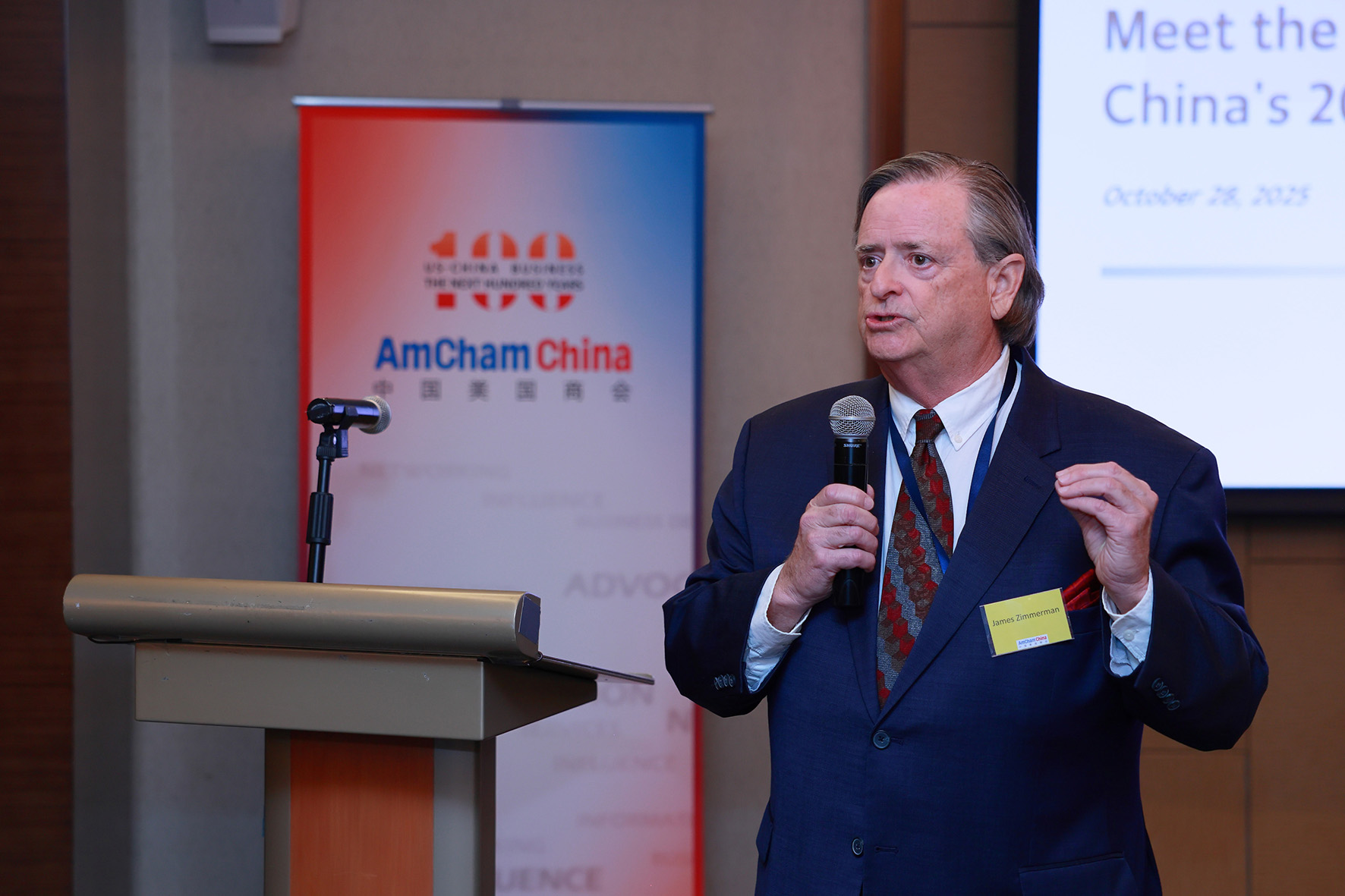
Photo by Jin Peng
Getting Back to Basics
The advocacy environment has shifted since Zimmerman last held the chairmanship, and not in ways that make the job easier. The fundamental challenge, making the business case for engagement at a moment when the political mood in Washington often runs counter to it, has become considerably harder to navigate.
“The biggest change is that the narrative in Washington has shifted from seeing China primarily as a partner to increasingly viewing it as a competitor and even a threat,” he says. “What was once largely a debate focused on human rights and differences in our political systems has broadened to the point where every action is now viewed through the lens of national security. Unfortunately, this taints the view of the opportunities and benefits that engagement with China can bring.”
He does not place all the blame on either side. “On the Chinese side, Beijing doesn’t help when it antagonizes its regional neighbors or fails to provide a level playing field for foreign companies operating in China.” AmCham China, in his view, is most useful when it stays grounded in evidence rather than ideology. “AmCham China, as a voice of the American business community in China, is most effective when its advocacy efforts are fact-based. These facts, derived from our rigorous annual China Business Climate Survey (BCS) Report and our on-the-ground presence here, demonstrate the significant economic links between the US and China and the role American companies play in supporting jobs and growth.”
Asked about where US-China policy is heading, Zimmerman reads the current position as essentially “managed trade,” meaning, reciprocity-focused, concentrated on Chinese purchases of American goods. He adds that he thinks it falls well short of what is needed. “We need to get back to basics. We need a dialogue — followed by concrete action — on market access, trade and investment barriers, and non-discriminatory treatment for foreign companies, especially in government procurement. This getting back to basics is the only way we’ll make progress, after which we can expand the discussion to involve services and more.”
On decoupling, he is direct. De-risking — diversifying supply chains to reduce vulnerability — makes sense as business practice. Structural separation of the two economies does not. “Smart business leaders constantly evaluate and adjust their supply chain strategies as part of normal business planning.” Those pushing hardest for a China exit, he notes, are often acting on decisions made years before the current political environment and often driven by cost structures or business model shifts that have little to do with today’s headlines.
What 2026 Could Be
A potential presidential visit to China is one of the most closely watched items on this year’s agenda, and Zimmerman is under no illusions about what it can and cannot deliver. “I do believe this presents an opportunity, even if it produces no formal deliverables beyond a constructive discussion and photo opportunity. Dialogue matters, especially given the talk of decoupling during the past decade.”
Europe’s increasingly active engagement with Beijing has also caught his attention. A string of senior European leaders have visited China this year, signing arrangements and deepening commercial ties at a pace that Washington has yet to match. Zimmerman reads this less as a threat to US interests than as a potential opening. “Given that many of our member companies are also deeply integrated in the EU economy, any opportunities hammered out by our EU colleagues will ultimately benefit many US companies, especially if there are breakthroughs with market access and economic reform.” He also notes that the Europeans are pursuing a wider range of sectors than traditional trade delegations typically cover: tourism, education, and services alongside the standard commercial agenda. “Our European partners appear eager to pursue their own commercial opportunities in China rather than waiting for a unified Western approach.”
The broader instability of 2026’s opening months adds another layer of difficulty for the business community. Zimmerman doesn’t minimize it. “Businesses need stability and thrive on certainty, but many of these geopolitical events are the antithesis of that. Being forced to react to events over which a company has no control or being pulled into the middle of a dispute that may have political recriminations on both sides is incredibly difficult for companies to deal with.”
His goals for the year, set against all of this, are focused. “I want this year to be a productive year in US-China relations. A year where we can look back and say that the AmCham China community did its best to help stabilize the relationship between Washington and Beijing, in much the same way we have been doing for four decades,” he continues, “In practical terms, that means strengthening our advocacy on behalf of member companies, expanding engagement with policymakers on both sides, and continuing to provide the data and analysis that inform the policy debate.”
Bandits, Books, and Beijing
Zimmerman’s relationship with China goes well beyond the immediate policy agenda. His 2023 book, The Peking Express, tells the true story of a 1923 train robbery in which a band of Chinese brigands seized a luxury passenger express and held dozens of hostages — several of them American — for over a month. The incident set off a political crisis that reached the highest levels of government in both Beijing and Washington, and yet had been almost entirely forgotten. The book is now being adapted for the screen.
“I have always been fascinated by the role of Americans and American business in China in the early 20th century,” he says. “Many were adventurers, opportunists, and scallywags, but all played a role in developing China, from the railroads to infrastructure to China’s pre-war legal system.” The research took him on more than a dozen visits to Shandong province, where the raid occurred. When he first began going, the story was not well-known. “When I started researching the story, I realized that few in Shandong province were aware of the heist and political intrigue surrounding the events,” he remarks. By the time the book appeared, local officials had started promoting the sites as historical attractions. “Notwithstanding the challenges during the Warlord Era in the 1920s, the local authorities now see this as a positive story for China.”
The Longer Story
American companies operating in China have adapted more than most realize. “American companies see the opportunities in China’s immense market but also understand the political risks of doing business here. Businesses and their leaders have evolved and adapted to the environment.” The conversations happening inside companies right now — between China operations and global headquarters — are less about whether to stay than about what comes next, Zimmerman believes. Ultimately, though, he says engagement is in the US’s best interest: “China brings real value to the American people and benefits Washington’s long-term economic and national security interests.”
This article is from the AmCham China Quarterly Magazine (Issue 1, 2026). To access the entire publication for free, sign up on our member portal here.