
Beyond the Hype: Why China’s Innovation Story Demands a Movie, Not a Snapshot
Eight years of research into China’s innovation ecosystem has led CSIS’s Scott Kennedy to one clear conclusion: the story is far more complicated than the headlines suggest. In this conversation, Kennedy cuts through both the hype and the alarmism to map where China is genuinely pulling ahead, where it continues to fall short, and why the assumptions driving policy in Washington may be doing more harm than good.
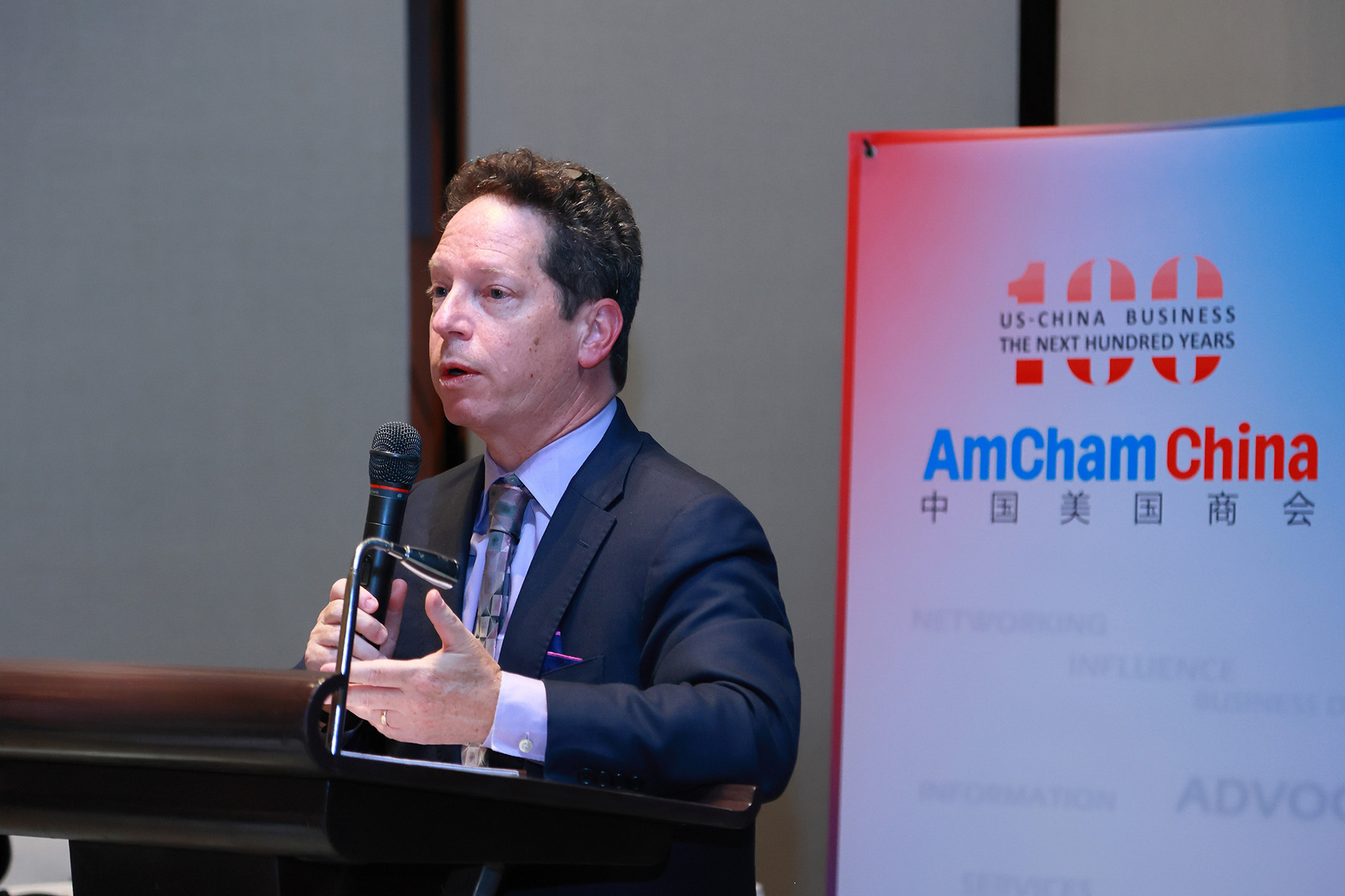
Scott Kennedy is senior adviser and trustee chair in Chinese Business and Economics at the Center for Strategic and International Studies (CSIS). A leading authority on Chinese economic policy and US-China commercial relations, Kennedy has been traveling to China for 38 years. His ongoing areas of focus include China’s innovation drive, Chinese industrial policy, US-China relations, and global economic governance. His articles have appeared in a wide array of policy, popular, and academic venues. His major publications include The Power of Innovation: The Strategic Value of China’s High-Tech Drive (CSIS, 2026); Managing US-China Tensions over the Global Economic Order (CSIS, 2024); US-China Scholarly Recoupling (CSIS, 2024); Breaking the Ice (with Wang Jisi, CSIS, 2023); China’s Uneven High-Tech Drive (CSIS, 2020); Global Governance and China (Routledge, 2018); The Fat Tech Dragon (CSIS, 2017); and The Business of Lobbying in China (Harvard University Press, 2005).
Kennedy hosts the China Field Notes podcast. From 2000 to 2014, Kennedy was a professor at Indiana University (IU), where he established the Research Center for Chinese Politics and Business and was the founding academic director of IU’s China Office. Kennedy received a PhD in political science from George Washington University, an MA from Johns Hopkins School of Advanced International Studies, and a BA from the University of Virginia.
Photo by Jin Peng
Your new report, The Power of Innovation, draws on eight years of research and paints a nuanced picture of China’s technological rise. What is the core argument, and why does it matter now?
Scott Kennedy: The overall argument is that China has made tremendous strides over decades, but their progress has been uneven. The ecosystem is much stronger in many dimensions — funding, talent, research organizations, infrastructure, supply chains — all of which have improved considerably. But weaknesses remain: an inefficient financial system, including a weak venture capital ecosystem, an IP environment that has improved but still falls short, government institutions that remain too siloed, and weak rule of law.
At the industry level, China has made enormous gains in many sectors — narrowing the gap or becoming a peer competitor — but not everywhere. China’s sweet spot is in industries that reward incremental learning and economies of scale, like EVs and solar panels. Where that formula doesn’t apply — commercial aircraft, precision machinery, jet engines — the outcome has been more mixed. China has certainly transformed technologically, but there are persistent weaknesses that are not going to disappear anytime soon.
What finding in the report most surprised you, or genuinely changed your own thinking?
Scott Kennedy: The biggest surprise was the pharmaceutical industry. China’s IP environment has been far from ideal; there have been medical scandals, damaging trust in the healthcare system; public hospitals face limited market competition; there has been significant corruption around access to doctors; and there are price caps on drugs. Together, these factors reduce incentives to innovate and would seem to be a terrible environment for a pharmaceutical industry to develop. And yet China accounted for roughly 30% of new innovative drugs on the global market in 2024 and 2025, on top of being a leading location for clinical trials and playing a major role in generics and APIs.
The answer to this puzzle is essentially a story of talent — Chinese researchers who studied in universities and worked abroad in major pharmaceutical firms, then returned home and made progress year after year, decade after decade. Without that globalization of talent and continued connectivity, none of it would have been possible.
This is a surprise in two ways: one, that China was able to do it at all; and two, that it’s not a story of self-reliance, it’s about deep connectivity with the rest of the world. Chinese tech success is about moving up the value chain while remaining deeply integrated in a global ecosystem.
Setting aside whether China has benefited from researchers returning after gaining knowledge abroad — is this good for the rest of the world?
Scott Kennedy: In biopharma, yes — though not across the board. Some Chinese successes are what I’d call “destructive successes,” built on subsidies and unfair policies that undercut markets where others have been competing well — EVs, solar panels, aluminum, and steel fall into that category. Pharmaceuticals are different, what I call a “conforming success.” Chinese companies are collaborating heavily with foreign partners, and the products they’re making are therapies designed to address real health problems. The more solutions available to patients around the world, the better. If those therapies make people healthier without significant side effects, that’s a huge positive for patients and healthcare systems around the world.
Your report challenges two dominant narratives — that China can’t innovate, and that it’s already taking over. Where does reality land?
Scott Kennedy: China can innovate, but many successes have been genuinely bottom-up — emerging from labs far from officials, growing organically, and only eventually receiving official endorsement. Much of what has occurred in AI and biopharma wasn’t something industrial planners saw coming. China has come a long way, but significant weaknesses persist. Consider that China’s per capita income is around $14,500 — the US is roughly five times that — yet China already ranks 10th globally in innovation. By that measure, it’s punching well above its weight.
You categorize China’s tech sectors into four types of success and failure. What conditions allow China to compete — and even lead — globally, and where will it struggle?
Scott Kennedy: The Global Innovation Index, maintained by the World Intellectual Property Organization (WIPO), uses 78 metrics measuring both inputs and outputs to innovation. In our report, we include a table breaking these down into areas where China has done well and areas where it has struggled. In terms of raw outputs, China ranks fifth in the world, sixth in infrastructure and business sophistication, eighth in knowledge and technology outputs including patents — and, in some categories, first. It’s remarkable. At the same time, it ranks 20th in human capital. That’s because, alongside the highly educated young people emerging from universities in coastal cities, two-thirds of young Chinese are rural, and two-thirds of rural Chinese don’t finish high school. It’s a profound imbalance — one in which some people will only ever engage with AI from a Meituan scooter.
In terms of institutions, China has made genuine improvements in one-stop government services and e-government, but significant bureaucratic weaknesses remain in horizontal and vertical coordination, principal-agent problems between leaders and implementers, rule of law, and worsening fiscal challenges at the local level as revenue declines and expenses rise as shares of GDP.
China has real ecosystem strengths, but you can’t extrapolate from the successes to assume everything will eventually follow — that China will crack advanced semiconductors, fusion energy, jet engines, and everything else. Challenges will persist. The same is true in the United States: we have a financial system that is very good at mobilizing capital when profitable opportunities are visible to investors, but we lack patient capital — and many things that need to be done well over the long term would benefit from exactly that. Different countries, different ecosystems, different results.
If you had to pick one sector where China will close the gap quickly, and one where it will continue to struggle, what would they be?
Scott Kennedy: China has had industrial policy on semiconductors in place since 1994 and has always struggled. But in recent years they’ve made significant progress in memory and GPUs and are not as far behind as they used to be. They’re also compensating through other means: more efficient AI models, open-source rather than proprietary large language models. I expect they’ll continue to narrow the gap in chips, though equipment is harder — lithography, where ASML dominates, will be more difficult to close the gap.
Commercial aircraft is a different story. In my judgment, China is as far behind today as it was 15 years ago. Last year, COMAC delivered 15 C919s, while Boeing and Airbus each delivered 20 to 40 times more of their comparable aircraft. COMAC is looking to ramp up, but there will be significant constraints on its ability to do so, and the C919 still relies largely on foreign technology. The C929 wide-body is on the drawing board, but getting from drawing board to tarmac will be even harder.
People ask: why does China struggle in commercial aircraft when it has made strides in other complex transportation — fighter jets, high-speed rail? Fighter jets are about capability and efficiency, not reliability; commercial aviation is the opposite. High-speed rail involved large technology transfers from Germany and Japan, and operates in 2D, not 3D. Keeping a plane aloft for 12 hours per day, day after day, is a fundamentally different challenge.
Where are policymakers and business leaders most misreading China’s innovation trajectory today?
Scott Kennedy: Policymakers tend to hold two contradictory images simultaneously, both of which contain elements of the truth. On one hand, they see Sputnik moment after Sputnik moment — new large language models, Chinese EVs everywhere, moon missions — and then, in the next breath, China is an economic basket case, drowning in debt, “playing with a pair of twos.” It’s not unusual to find the same person holding both opinions.
The challenge for all of us is that China isn’t black or white; it’s shades of gray. If you went to China for the 2008 Olympics and haven’t been back since, it has changed enormously in those 18 years. Alternatively, we need to view China as a movie, which is constantly in motion, not a still photograph.
The second misreading is Washington’s tendency to conclude that China is winning the industrial policy competition, so we must do the same. That overstates both the consistency of China’s successes and the role industrial policy actually plays. Many gains happened in spite of industrial policy, or only worked because of openness to foreign investment, talent, and global connectivity — as we saw in pharmaceuticals. If not extremely careful, copying what we think China is doing well may end up slowing our technological upgrading.
The third is the belief that China’s doors are entirely closed to foreign businesses. In some industries, competition from domestic firms or state policy has been a severe obstacle to success. But many companies have adapted and are still doing well — some are better positioned globally precisely because they competed in that environment.
Properly evaluating where China stands, the real value of industrial policy, and the potential opportunities — or lack of them — for American companies in China: those are three areas where Washington consistently lands at one extreme or the other, rather than somewhere in the realistic, messy middle.
Military-civil fusion (MCF) gets a lot of attention in compliance circles. How much commercial technology is actually flowing into China’s military, and how should multinationals be thinking about their exposure?
Scott Kennedy: What surprised me was how relatively small the direct military spending on MCF is, especially relative to China’s overall military budget or R&D spending. The primary tools are policies and institutions bridging the military and commercial companies — it’s about connectivity, not subsidies.
Progress in weapons systems has been more limited. Most of the meaningful activity is in dual-use technologies or standard commercial goods where the customer happens to be the PLA. Looking at R&D collaboration, PLA procurement of dual-use technologies, and specific areas where private companies are developing products with military value, you can see movement. A Georgetown CSET report last fall found that around 70% of AI-related military contract winners were non-traditional companies.
Private firms are also advancing in reusable rockets, low-orbit satellite clusters to compete with Starlink, and batteries — highly relevant in military contexts, especially in extreme environments or where access to energy is limited.
That said, MCF could go further. The PLA doesn’t fully trust private companies, partly because many have international ties seen as a security risk. Chinese companies operating globally often want nothing to do with MCF, as it could damage their international business. Progress is real and making a difference in certain areas of military preparedness, particularly outside weapons systems; but if China resolves the trust issue, it could become far more consequential for Western military planners.
You argue that US efforts to exclude Huawei from standards bodies may have backfired. What’s the lesson here?
Scott Kennedy: The 2019 order placing Huawei on the US’s Entity List for export controls explicitly referenced its participation in international standards bodies, warning that other participants risked violating export control laws if sensitive information was shared in Huawei’s presence. Several standards bodies expelled Huawei, and American companies were effectively silenced whenever Huawei was in the room. The standards organizations largely backtracked within a week or two, but American companies continued to face that legal exposure for years. The Biden administration issued a notice in 2022 modifying the restriction without fully eliminating it, and it wasn’t until 2024 that the administration finally clarified that the Entity List and standards participation were entirely separate matters.
But the damage had been done. Huawei built a Plan B: HarmonyOS, now fully independent of Android with 36 million devices worldwide as of end-2025; and NearLink, a wireless standard rivaling Bluetooth and Wi-Fi, now shipping on all Huawei devices and those of Spark Link Alliance members. Huawei and other Chinese companies have also established standards consortia in China, attracting international participants, with the potential to produce further alternatives to globally adopted standards. The result is the potential fragmentation of the international standards system, which is absolutely not in the US interest. American business and national security benefit enormously from a single unified global standards framework. Fragmentation brings nothing of value, economically or in terms of national security. This is a clear case where the policy backfired because insufficient forethought went into the original decision.
At the heart of your policy recommendations is what you term “calibrated coupling.” For a CEO making investment or sourcing decisions right now, what does that look like in practice?
Scott Kennedy: Calibrated coupling is a framework for how the US and its allies should manage interdependence with China. The core idea: interdependence carries both benefits and risks, and we should maximize the benefits while minimizing the risks.
The benefits are real — market access, innovation opportunities, access to talent, the opportunity to maintain our technology leadership and have Chinese industry within our ecosystem, and more. But so are the risks — technology leakage, data security, and overdependence on Chinese supply chains, to name a few.
That framing cuts against two older views about interdependence — it’s all upside (engagement), or it’s all downside (hence the call for decoupling) — both of which miss the mark. What I’m suggesting is that the US government and its allies be far more nuanced about how to accentuate the positive and mitigate the negatives.
For companies, nuance is actually quite natural. They already know how to protect sensitive technologies, manage supply chain risks, and stay ahead of the competition. The harder challenge has been making the case to policymakers that doing business with China, properly managed, serves US national interests beyond corporate profit. Europe, Japan, South Korea, and Taiwan already understand this balance. The US would be wise to move in the same direction.
One final question: with this report in mind, but also given the wider state of the world today, what’s the one thing that AmCham China members need to be thinking about most for 2026?
Scott Kennedy: American companies cannot stand still, and you can’t wait for someone else to come help you. You’re going to have to keep innovating, or you’re going to be left behind. Being in China can help with that process if done it correctly, but it also comes with risks. Resting on your laurels, hiding behind protectionist walls, going home — that’s a sure path to irrelevancy. Being on offense with your technology, your business model, and your public affairs strategy – that’s really the only approach that gives you a chance at long-term success, in China and globally.
This article is from the AmCham China Quarterly Magazine (Issue 1, 2026). To access the entire publication for free, sign up on our member portal here.